How to Elope in Patagonia: The Complete 2026 Guide
PUBLISHED JULY 7, 2026 · UPDATED AUGUST 20, 2026
The short answer
To elope in Patagonia, sign legal paperwork at home and hold a symbolic ceremony beneath the peaks, since Chilean and Argentine civil marriage is impractical for visitors. Choose Torres del Paine in Chile for the most dramatic sunrise or El Chaltén in Argentina for free trail access, travel between November and March, and build buffer days for wind and weather.
Chile or Argentina? The honest comparison
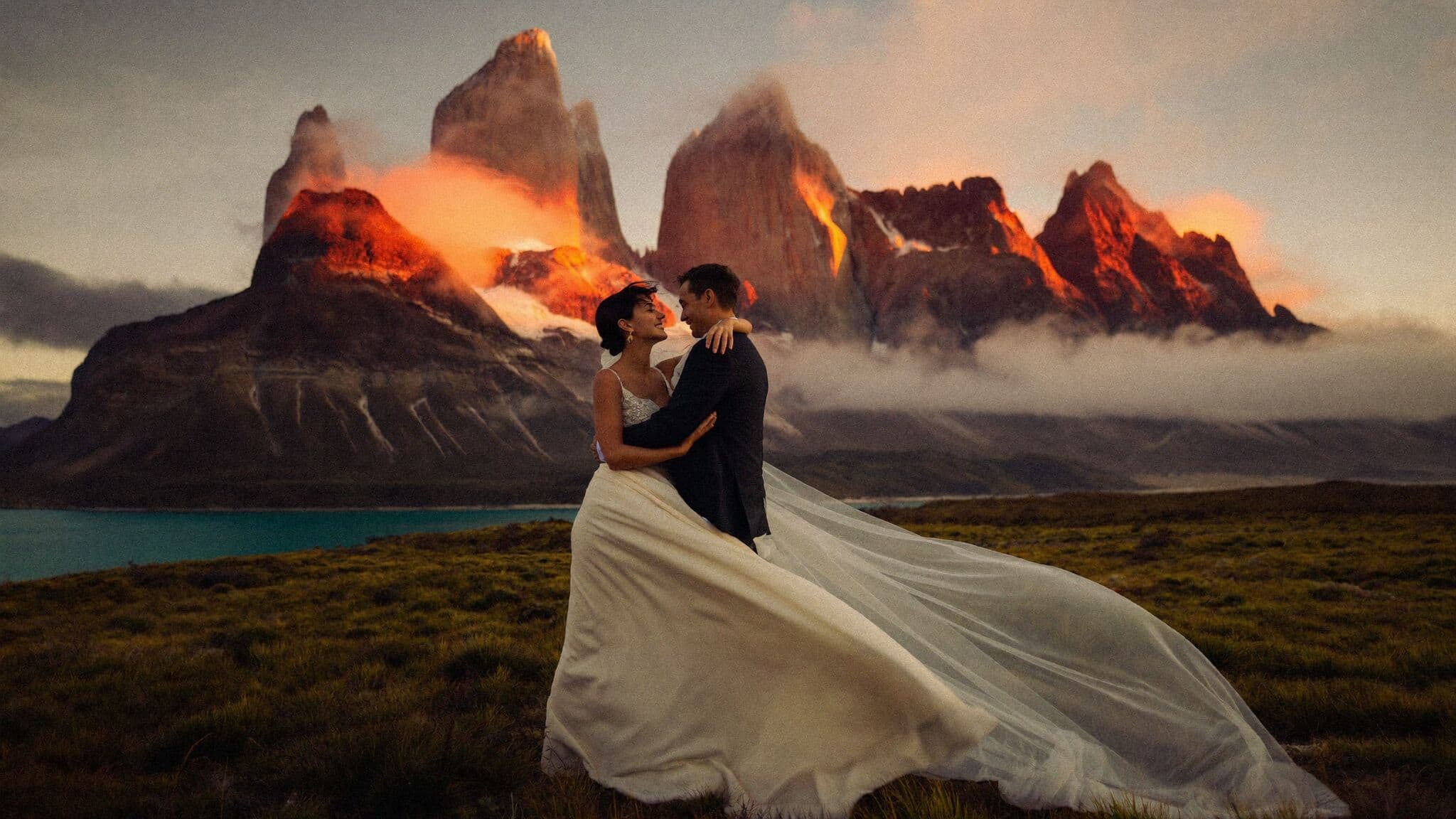
Patagonia spans two countries, and your first planning decision is which side anchors the trip. Torres del Paine, on the Chilean side, delivers the single most dramatic sunrise in the elopement world: the granite towers and twisted black-and-granite horns of the Paine massif lighting up red above turquoise Lago Pehoé. It is a managed national park with booked entries, and the nearest town, Puerto Natales, sits about two hours out.
El Chaltén, on the Argentine side, is a walkable trekking town at the foot of Cerro Fitz Roy where the trails start from the street grid and cost nothing. The Mirador de los Cóndores is a 45-minute walk for huge views over town; Laguna de los Tres is a committed full-day hike we reserve for genuinely fit couples. Eighty minutes from El Calafate, the Perito Moreno glacier adds a 70-metre wall of blue ice with wheelchair-accessible boardwalk views, a rarity in this part of the world.
With five or more days we usually cross the border and do both, roughly six hours' drive including the crossing. With fewer, pick the sunrise or the freedom, and we will tell you plainly which fits your fitness, budget and dates.
Why we recommend a symbolic ceremony here
We recommend the symbolic route in Patagonia without hesitation, more strongly than anywhere else we work. Legal civil marriage in Chile or Argentina involves civil registry appointments, document translations, witnesses and in-country lead time, and in Argentina marriage is generally handled at the registry office of the district where one party resides, which rules out a mountainside legal ceremony anyway.
So nearly all of our Patagonia couples sign legal paperwork at their local courthouse the week before or after the trip, then hold their real ceremony beneath the towers with vows, rings and a celebrant or a self-officiated reading. It changes nothing about how the day feels, and it frees the itinerary completely, which matters more here than anywhere, because Patagonian weather does not negotiate with appointment calendars.
Park rules that shape the day
Torres del Paine entries are booked online in advance, and the park expects professional photography to be arranged through the proper channels, which we handle as part of planning. El Chaltén's trails, inside Los Glaciares National Park, remain free for small groups with no ceremony permit needed. Drone use is prohibited in both parks, no exceptions worth chasing.
The practical rules matter as much as the official ones. Distances are real: you are three flights from most homes, park roads are gravel, and the best light happens at 5 a.m. in midsummer. We build itineraries with weather margins, keep a road-accessible backup like the Mirador Cuernos area on every plan, and treat buffer days as core infrastructure rather than padding.
The wind is not a rumour
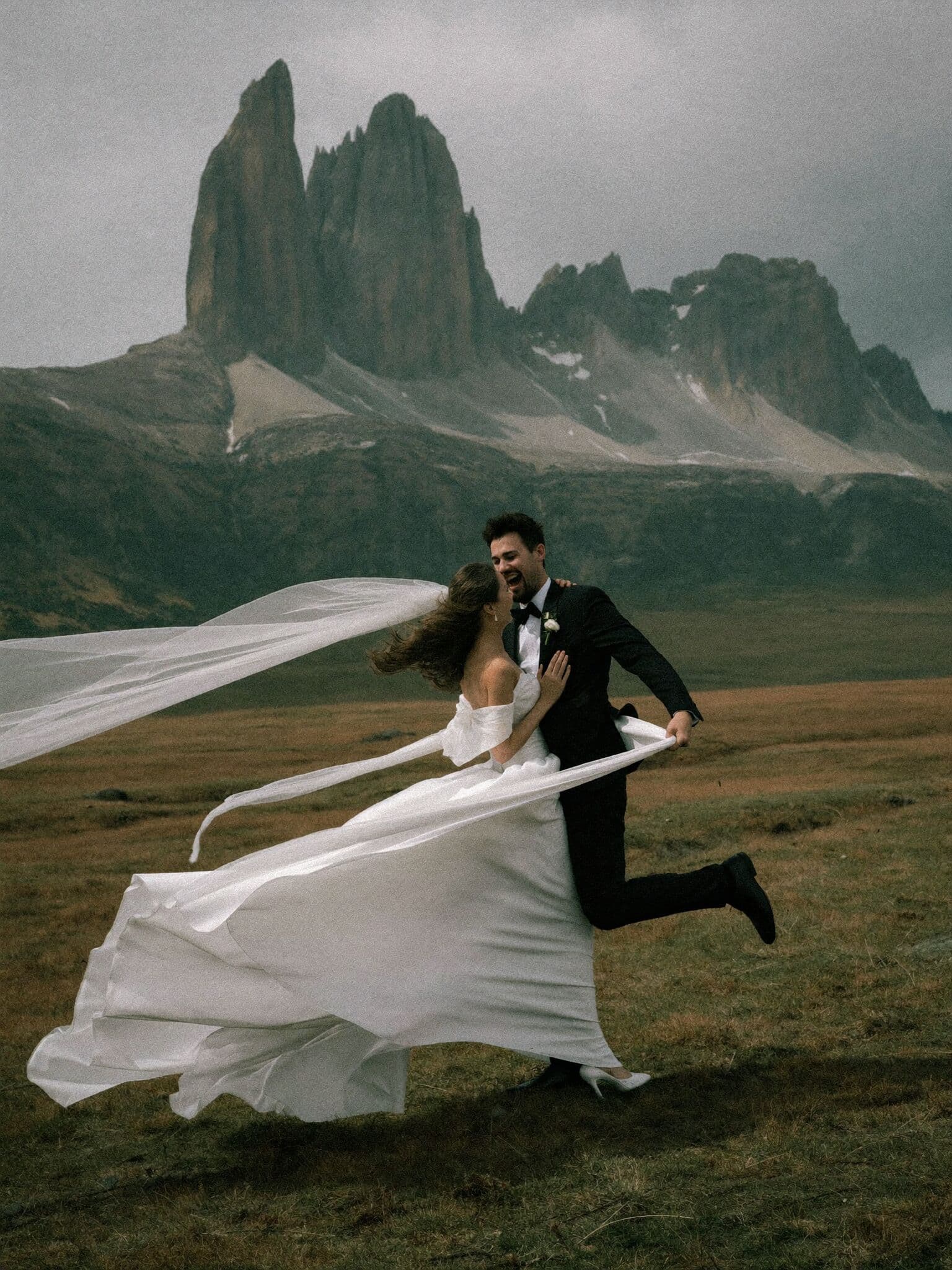
Every Patagonia guide mentions wind. Here is what it actually means: sustained 40 to 60 km/h is normal in summer, gusts near 100 km/h happen, and the westerlies pouring off the ice cap are strongest from November to February, easing noticeably in March and April.
We plan for it rather than around it. Ceremonies go in wind shadows we have scouted, everything gets weighted or clipped, vow books are printed small and stiff, and we brief you on veil physics before you order one. Couples who embrace the wind get the most alive-looking wedding photographs we make anywhere: veils flying, dresses turned to sails, hair doing what it wants. A still morning down here is a gift, and we treat it like one.
When to go: November to March, and the autumn secret
| Months | Conditions | Our verdict |
|---|---|---|
| November – December | Southern spring, long days, strong wind, wildflowers | Green landscapes and great light, pack for gusts |
| January – February | Peak summer, 5–20°C, strongest wind, 17-hour days, busiest trails | Maximum access and daylight, book a year out |
| March – April | Autumn reds in the lenga forests, calmer wind, colder nights | Our favourite: colour, softer light, fewer people |
| May – October | Southern winter, snow, short days, many services closed | Experienced cold-weather couples only |
Getting there and getting around
Patagonia is the far end of the elopement map, and the routing reflects it. For the Argentine side, fly long-haul to Buenos Aires, connect to El Calafate, then drive about three hours to El Chaltén. For the Chilean side, fly to Santiago, connect to Puerto Natales or Punta Arenas, and drive to Torres del Paine. Both itineraries want a rental car, and both reward five to seven nights minimum on the ground.
Lodging splits between small hotels in the towns, refugios inside the parks, and estancias, working sheep stations that host ceremonies, asados and overnights with the mountains behind and nobody else in sight. The estancia dinner after a mountain ceremony is Patagonia's answer to the rifugio, and we book it as part of planning.
What it costs
Our Patagonia packages start at $5,000 for 8 hours with travel included, but because distances here are real, most couples choose the two-day format from $8,500 or a multi-day itinerary spanning both countries at up to $12,000. Add long-haul flights, internal flights to El Calafate or Puerto Natales, park entries, a rental car and five to seven nights of lodging, and realistic all-in budgets run $12,000 to $20,000. It is the most expensive trip on our map and the one couples most often call the best thing they have ever done.
Quick answers
Can foreigners legally get married in Patagonia?
Technically yes, practically no. Chile and Argentina route marriage through civil registries with documents, translations, witnesses and in-country timelines, and Argentine registries generally require a local connection. Almost every couple signs legal paperwork at home and holds a symbolic ceremony beneath the peaks, losing nothing from the day.
How windy is Patagonia really?
Genuinely windy: sustained 40 to 60 km/h is normal in summer and gusts near 100 km/h happen, strongest November to February and calmer in March and April. We plan ceremonies in wind shadows, weight everything, and brief you on veil physics before the day.
Should we choose Torres del Paine or El Chaltén?
Torres del Paine delivers the most dramatic sunrise and booked-entry park infrastructure; El Chaltén offers free trail access, Fitz Roy and a walkable town, with Perito Moreno's glacier nearby. With five or more days we cross the border and do both, roughly six hours' drive with the crossing.
How much does a Patagonia elopement cost?
Most couples book our two-day format from $8,500 given the distances, though 8-hour coverage starts at $5,000. With long-haul and internal flights, park entries, a rental car and five to seven nights of lodging, realistic all-in budgets run $12,000 to $20,000.
Keep reading
Begin the enquiry
Tell us where the map is pulling you
Enquiry-only packages from $5,000 for eight hours to $12,000 for a multi-day expedition, travel included. We answer every enquiry personally within 48 hours.